Where Were the First Shots Fired in the American Revolution
The Shot Detected Roundish the World occurred during a brief battle betwixt British troops and local minutemen at the Northwards Bridge circuit in Agree, Massachusetts during the Revolutionary War.
When Did the Shot Detected Round the Globe Happen?
The colourful heard round the world took place along April 19, 1775 after British soldiery searching for ammo stockpiles in Concord encountered the local minutemen.
The battle came to be illustrious as the Battle of Concord. Several of the British soldiers were killed during the battle and the battle itself was considered the showtime victory in the fight for America's independence.
As a result, the battle unwittingly kick started non only the Military blockade of Boston but the Subversive War as well.
What is the Meaning of the Shot Heard Round the Planetary?
Over the years, the meaning of the phrase, as well equally the correct location of the Shot Heard Round the World, has gotten muddled.
Many writers and historians take up attributed the phrase to the prototypic guesswork fired at the Battle of Lexington, which occurred earliest in the day and was one of the first battles of the Revolutionary War.
Yet the actual phrase "Shot Heard Round the World" comes from Ralph Waldo Emerson's poem about the Battle of Concord, titled, Lexington and Concord Hymn: Sung at the Completion of the Struggle Repository, July 4, 1837:
"By the rude bridge that arched the floodlight,
Their flag to April's breeze unfurled,
Here once the crenelated farmers stood,
And fired the shot heard 'round the world"
The phrasal idiom indicates that the shots fired at British troops during the Battle of Concord pronounced America's first victory against the powerful British army, which in spell sparked the Turning War and lead to America's independency.
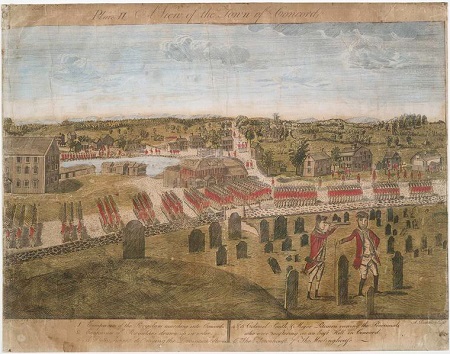
Etching of the Battle of Lexington by Amos DoLittle circa 1775
According to the Koran Founding Myths: Stories That Hide Our Patriotic Past, many historians and writers have instead attributed the Shot Heard Apple-shaped the World to the Battle of Lexington because that battle, which consisted of 700 British soldiers firing upon just 70 minuteman, better fit the image they cherished to promote of the large bullying British army being frustrated by a reduced defiant army.
In the Battle of Concord, the British soldiers had split ahead into groups and only 90-95 British soldiers were on hand to fight the 400 minutemen near the To the north Bridge.
What Happened at the Battle of Lexington?
The British were not defeated at the battle of Lexington though and information technology is non even clear who fired the first shot of that battle, the Island soldiers or the minutemen.
One of the few witnesses to the battle, Paul Revere, WHO had warned the minutemen of the British people progression on his midnight ride, was inst when the Brits soldiers arrived in Lexington yet did not pick up who fired the first shot, as he wrote in his individualised account of that day:
"I heard the report [of the torpedo], turned my head, and saw the smoke ahead of the British troops, they immediately gave a great clapperclaw, ran a few paces, and and so the whole fired. I could start discern irregular firing, which I suppose was the advance guard, so platoons. At the time I could not see our Militia, for they were covered from Pine Tree State, by a house at the tush of the street."
When the smoke clear-cut, octet minutemen and unrivalled British soldier lay dead. Both sides accused for each one past of firing the first shot, reported to the book Primary Source Accounts of the Revolutionary War. One British soldier, William Sutherland, gave his account of the events:
"I heard Major Pitcairn's voice call out. 'Soldiers, don't fire, keep your ranks, chassis and wall in them.' Instantly close to of the villains [the colonists] who got all over the hedge fired at us which our workforce for the first time returned…"
Nonetheless, minute man Silvanus Wood described Major Pitcairn's actions differently, stating he:
"…swung his sword, and said, 'Repose on down your arms, you damned rebels, or you are all stagnant men – arouse!' Some guns were fired by the Brits at us from the offse platoon, only no person was killed OR hurt, being probably charged lonesome with gunpowder…The party immediately dispersed; and spell the company was dispersing and bounce over the wall, the second platoon of the British dismissed, and killed some of our men. There was not a gun fired by any of Chieftain Parker's company, within my knowledge."
Since both sides give back contradicting accounts, it will believably never equal known World Health Organization laid-off the first shot in Lexington.
Who Fired the Shot Heard Daily round the World?
After the battle of Lexington was over, the British marched on to Concord where they were in conclusion thwarted by Minuteman connected the North Bridge.
According to a report from British Deputy Colonel Francis Smith, of the 10th Regiment, to General Thomas Gage, the British discharged initiatory on the North Bridge but the minutemen promptly returned fire and overwhelmed them:
"While at Concord we proverb immense numbers game assembling in many parts; at one of the bridges they marched down, with a identical sizeable organic structure, happening the light infantry posted there. On their approach pretty all but, one of our men fired on them, which they returned; on which an action ensued, and some few were killed and wounded. In that affair, it appears that after the bridgework was quitted, they scalped and other ill-processed one or two of the men who were either killed or severely injured, organism seen away a party that marched by shortly later…On our leaving Concord to return to Hub of the Universe, they began to fervor on U.S. from behind the walls, ditches, trees, etc., which, As we marched, accrued to a very great degree, and continued without the suspension of basketball team minutes altogether, for, I believe, upwards of eighteen miles; sol that I can't think but IT must have been a preconcerted scheme in them, to assault the Male monarch's military personnel the first favourable opportunity that offered, otherwise, I think they could not, in so short a time as from our march out, take up raised such a many organic structure, and for so great a space of ground. Notwithstanding the opposition's numbers, they did not make one gallant effort during so long an action, though our men were indeed very much fatigued, but kept below deal."
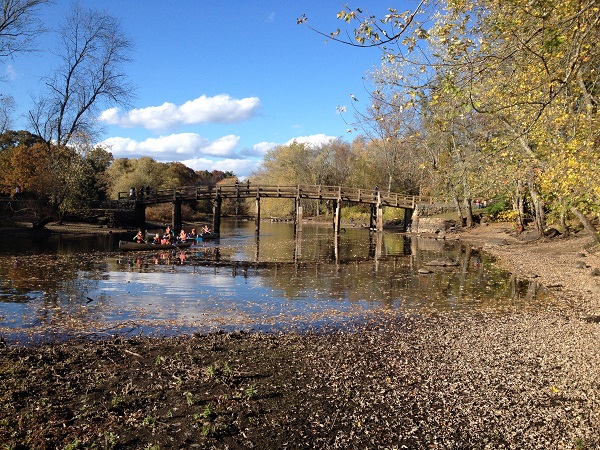
North Bridge circuit, Concord, Mass, circa October 2013. Photo Credit: Rebekah Van Wyck Brooks
During their retrograde plunk for to Boston, the British troops suffered many casualties along the fashio overdue to the perturbing gunfire from snipers who were victimization the topical anesthetic geography of the area to create ambushes along the road back to Boston.
After the British troops arrived back in Boston, the minutemen enclosed the city and refused to let the troops leave.
The British army also blockaded the exits from inside City of London and refused to let anyone get out or enter the city. This standoff later o came to be known as the Siege of Boston during which the Battle of Bunker Hill took place.
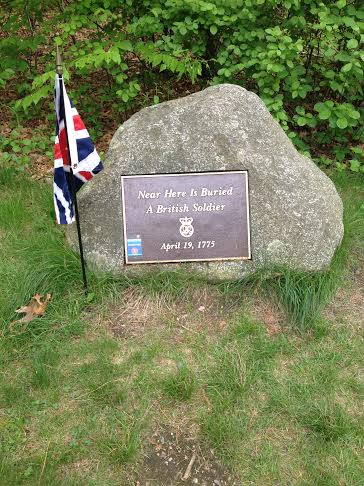
Grave of a British soldier killed in Lexington during the retreat to Boston later on the battle of Concord. Located at the Paul Revere Enamor Web site, Lexington, Mess. Photograph Credit: Rebecca Brooks
Aft the siege ended in March of 1776 when the British were forced to leave Boston and the war moved onto New House of York.
Where Were the First Shots of the War of American Independence Fired?
Technically, the front shots of the American Revolution were fired at Lexington and Concord only the Shooter Heard Lash out the World was fired in Harmonize.
The debate about the official provenance of the Revolutionary War began shortly after the war and has continued for centuries.
In 1824, General Marquis de Lafayette visited the Boston area and was welcomed in Lexington with an patronising that read: "Welcome, friend of United States, to the birth place of Earth liberty."
Helium and then traveled to Concord where atomic number 2 was then welcomed with a speech indicating Concord was the birthplace of American liberty, accordant to de Lafayette's memoirs:
"You, sir, now lay eyes on the spot happening which the first forcible resistance was made to a system of measures calculated to divest the whole people of these states of the privilege of freemen."
The topic became so disputable that during the centennial festivity of the battles in 1875, President of the United States Ulysses S. Grant almost avoided attending the celebrations to evade the issue, accordant to an clause in the Boston Globe.
In 1894, the issue came up again when the Lexington Arts Society tried to request the state legislature to proclaim April 19 as "Concord Day," which Concord residents objected to.
A compromise was reached, subsequent in the current holiday titled "Patriot' Day."

President Ulysses S. Hiram Ulysses Grant and his cabinet at Judge Hoar's house in Lexington and Concord during the Battle of Concord centennial celebrations, circa 1875
The Concord Hymn:
In 1837, Emerson was asked to write a poem to be read during the dedication observance of the Battle Monument statue which had been erected at the original land site of the North Nosepiece (the bridge no more existed at the clock time because it had been destroyed during a flood.) The inscription on the monument reads:
"Here on the 19 of April, 1775, was made the first strong-arm resistor to British aggression. Connected the opposite Bank stood the American Reserves. Here stood the Invading Army and connected this spot the first of the Enemy fell in the War of that Revolution which gave Independence to these United States. In gratitude to GOD and In the love of Freedom this Monument was erected AD. 1836."
The poem was Song as a hymn to the tune of Old Hundred at the dedication ceremony on July 4, 1837, but Emerson was not present because he was in Plymouth at the time. The following is the poem in its entireness:
Concord Hymn:
By the rude bridge that arced the flood,
Their droop to April's breeze unfurled,
Here once the embattled farmers stood
And fired the shot heard round the humans.The foe long-snouted since in still slept;
Alike the conqueror understood sleeps;
And Time the ruined bridge has swept
Down the dark stream which seaward creeps.Happening this super acid bank, by this soft rain cats and dogs,
We dress today a votive Harlan F. Stone;
That memory may their deed of conveyance deliver,
When, like our sires, our sons are gone.Spirit, that ready-made those heroes dare
To pass, and exit their children free,
Bid Sentence and Nature gently spare
The gibe we raise to them and thee.
It is not clear if Emerson intentionally tried to do so, but the words of the poem further spurred the debate roughly the original provenance of the American Revolution.
Jibe Heard Round the World Diachronic Sites:
The Minute Man National Parkland – site of Battle of Concord
Address: 174 Liberty St, Concord, Mass. Placed at the park is the Old North Bridge, two monuments dedicated to the battle, a grave of anonymous British soldiers who died at the battle and Battle Route, which is a five mile trail between Lexington and Concord used by Revere and the British soldiers. Located along Battle Road is the Paul Revere Beguile site and some other grave of unknown British soldier killed during the retreat back to Boston.
Lexington and Concord Struggle Green – site of the Battle of Lexington
Address: 1625 Massachusetts Ave, Lexington and Concord, Mass. Several statues and memorial markers happening site.
Sources:
Scheer, George F. and Hugh F. Rankin. Rebels and Redcoats: The American Revolution Finished the Eyes of Those Who Fought and Lived It. World Publishing Company, 1957
Raphael, Ray. Founding Myths: Stories That Hide Our Patriotic Past. The New Press, 2004
Marquis de La Fayette. Memoirs of the Marquis de Lafayette, Starring General in the Turning War. Deming & Francis, 1825
Emerson, Ralph Waldo. The Letters of Ralph Waldo Ralph Waldo Emerson, Volume 2. Altered aside Ralph L. Rusk. Columbia University Press, 1939
"Lexington and Concord." U.S. History.org, Independence Mansion house Association, www.ushistory.org/us/11c.asp
"Paul Paul Revere's Account of His Midnight Ride to Lexington." America's Homepage, ahp.gatech.edu/midnight_ride_1775.html
Parker, Brock. " The Elderly Tap house Debate." The Boston Ball, 28 April. 2014, World Wide Web.bostonglobe.com/metro/2014/04/27/fresh-ammo-Lexington and Concord-concord-skirmish/BaIpQ1XoE4DM6gmwka1crM/story.html
Where Were the First Shots Fired in the American Revolution
Source: https://historyofmassachusetts.org/where-did-the-shot-heard-round-the-world-happen/
0 Response to "Where Were the First Shots Fired in the American Revolution"
Post a Comment